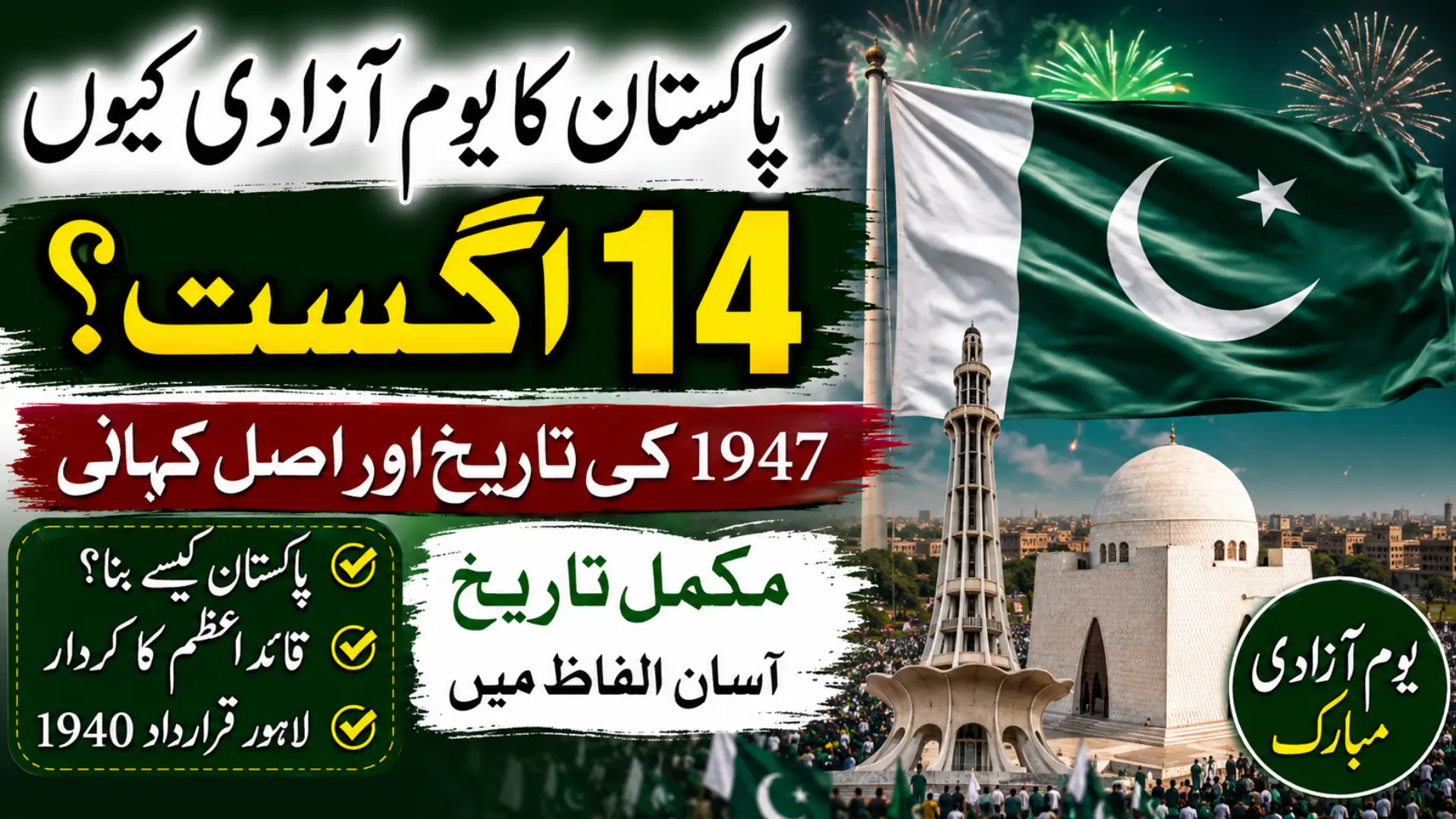
Pakistan Independence Day is celebrated every year on August 14. It is one of the most important national days in Pakistan because it marks the country’s independence from British rule and the creation of Pakistan in 1947.
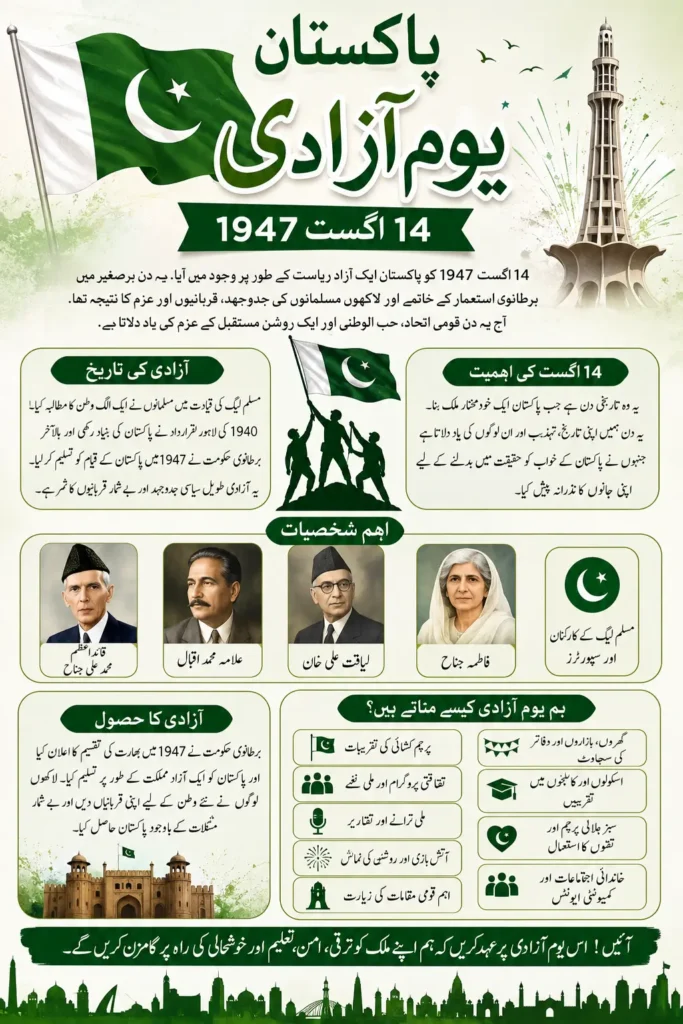
The question of the Pakistan Independence Day date 1947 can sometimes be confusing because the partition of British India officially took place around midnight between August 14 and August 15. Pakistan observes its Independence Day on August 14, while India celebrates its Independence Day on August 15.
When Is Pakistan Independence Day Celebrated?
Pakistan celebrates Independence Day on August 14 every year. The day is a national public holiday, and people across the country take part in flag-raising ceremonies, special events, speeches, cultural programs and other activities.
You can also read: Maryam Nawaz Azadi Offer In Soba Punjab
The date is closely connected with the end of British colonial rule in the Indian subcontinent. On August 14, 1947, Pakistan emerged as a separate independent state, following the passage of the Indian Independence Act 1947 by the British Parliament.
What Happened on August 14, 1947?
The creation of Pakistan was the result of a long political and constitutional struggle. During the final years of British rule, the All-India Muslim League, under the leadership of Muhammad Ali Jinnah, argued that Muslims needed political protection and a separate homeland.
The demand became especially important after the Lahore Resolution of 1940, which provided the political foundation for the creation of separate Muslim-majority states. After years of negotiations, the British government accepted the partition of British India, leading to the establishment of Pakistan in 1947.
Pakistan Independence Day 1947 at a Glance
| Important detail | Information |
|---|---|
| Independence Day | August 14 |
| Year of independence | 1947 |
| Country created | Pakistan |
| Major political leader | Muhammad Ali Jinnah |
| Main political organization | All-India Muslim League |
| Important resolution | Lahore Resolution, 1940 |
| Colonial power | British Empire |
| Neighboring new state | India |
| National holiday | Yes |
Why Is Pakistan’s Independence Day August 14?
The choice of August 14 is linked to the events surrounding the transfer of power and the establishment of Pakistan. The Indian Independence Act 1947 provided for the creation of two independent dominions, Pakistan and India.
There is also a historical timing issue. The formal transfer of power and partition occurred around the midnight period of August 14–15, 1947. Pakistan therefore commemorates its independence on August 14, whereas India observes August 15.
Who Led the Pakistan Movement?
Muhammad Ali Jinnah, popularly known as Quaid-e-Azam, was the central political leader of the Pakistan Movement and the first Governor-General of Pakistan. He played a major role in negotiations with the British government and the Indian National Congress.
The movement, however, was not the work of one person alone. Millions of Muslims supported the Muslim League and the demand for a separate homeland. Other important figures, political workers, scholars and ordinary citizens also contributed to the struggle.
Important Figures Associated With the Pakistan Movement
- Muhammad Ali Jinnah — leader of the Muslim League and first Governor-General of Pakistan.
- Allama Muhammad Iqbal — an important intellectual figure whose political ideas influenced the demand for a separate Muslim homeland.
- Liaquat Ali Khan — a close associate of Jinnah who became Pakistan’s first Prime Minister.
- Fatima Jinnah — an important supporter of the Pakistan Movement and a prominent public figure.
- Muslim League workers and supporters — played a major role in organizing political support throughout British India.
The Lahore Resolution of 1940
The Lahore Resolution, passed on March 23, 1940, was a major turning point in the Pakistan Movement. It called for the grouping of Muslim-majority areas into independent political units. The resolution later became closely associated with the demand for Pakistan.
The resolution was adopted at a Muslim League session in Lahore. Its political importance increased during the following years as negotiations over the future of British India became more complicated.
You can also read: Zakat Fund Check Online by CNIC
How Did British Rule End in the Subcontinent?
British control of the Indian subcontinent developed over several centuries, beginning with the growing influence of the British East India Company. After the uprising of 1857, the British Crown took direct control, beginning the period commonly known as the British Raj.
During the 20th century, political movements increasingly demanded independence. The Indian National Congress, the Muslim League and other political organizations pursued different visions for the future of the subcontinent. After World War II, Britain moved toward ending colonial rule, eventually resulting in partition and independence in 1947.
How Is Independence Day Celebrated in Pakistan?
Independence Day celebrations usually begin before August 14, with homes, markets, offices, schools and public buildings decorated with the national colors. Green and white flags, banners and lights can be seen in many cities.
On August 14, official ceremonies are held in different parts of the country. The national flag is raised, the national anthem is played and government officials deliver speeches about Pakistan’s history, sacrifices and future.
Common Independence Day Activities
- Flag-hoisting ceremonies
- Singing the national anthem
- National Day speeches and events
- School and college programs
- Cultural performances
- Green and white decorations
- Fireworks and light displays
- Patriotic songs and programs
- Family gatherings and community events
- Visits to important national monuments
Why Is August 14 Important for Pakistanis?
Independence Day is more than a public holiday. It is a day to remember the political struggle, sacrifices and hardships associated with the creation of Pakistan. The migration that followed partition also caused enormous human suffering and displacement.
For many Pakistanis, August 14 is an opportunity to reflect on the country’s history while also thinking about its future. The day encourages citizens to value national unity, responsible citizenship, education, peace and development.
Pakistan Independence Day and the Partition of 1947
Partition divided British India into two new dominions, Pakistan and India. The division created one of the largest mass migrations in modern history, as millions of people moved across the newly created borders.
The period was also marked by severe communal violence and loss of life. Remembering these events provides important historical context for understanding why Pakistan Independence Day carries such deep emotional and national significance.
You can also read:
Common Mistakes About Pakistan Independence Day
Several historical details are sometimes presented incorrectly in online articles and social media posts. A few basic facts should be kept clear when discussing Pakistan’s independence.
- Pakistan celebrates Independence Day on August 14, not August 15.
- Pakistan was created in 1947, not 1940.
- The Lahore Resolution was passed in 1940 and was an important milestone in the Pakistan Movement.
- Muhammad Ali Jinnah was the leading figure of the Muslim League during the final phase of the independence struggle.
- Pakistan’s independence should be understood in the wider context of the 1947 partition of British India.
How to Teach Children About August 14, 1947
For students, the best way to understand Independence Day is to connect the date with the broader historical story rather than simply memorizing August 14. They should learn about British rule, the Pakistan Movement, the Lahore Resolution, the role of Muhammad Ali Jinnah and the events of partition.
Students can also learn through historical books, documentaries, school presentations and visits to national monuments. Reliable sources are especially important because social media posts can sometimes mix historical facts with incorrect claims.
Conclusion
The Pakistan Independence Day date 1947 is August 14. It marks the establishment of Pakistan as an independent state at the end of British rule in the Indian subcontinent. The date remains a powerful reminder of the political struggle that led to the creation of the country.
You can also read: BISP 8171 SIM Wallet 2026 Registration
Every August 14, Pakistanis celebrate with flags, ceremonies, national songs and public events. At the same time, the day provides an opportunity to remember the sacrifices associated with independence and to consider how citizens can contribute to a stronger, peaceful and prosperous Pakistan.
Frequently Asked Questions
When is Independence Day in Pakistan celebrated?
Pakistan celebrates Independence Day every year on August 14. It is a national public holiday.
What does Pakistan Independence Day commemorate?
It commemorates the establishment of Pakistan as an independent state in 1947 following the end of British rule and the partition of British India.
Who led the demand for Pakistan?
Muhammad Ali Jinnah was the leading figure of the All-India Muslim League during the final stage of the Pakistan Movement and played a central role in the creation of Pakistan.
Why does India celebrate Independence Day on August 15?
India observes its Independence Day on August 15. The partition and transfer of power took place during the midnight period of August 14–15, 1947, which is why the two countries observe their national days on consecutive dates.
What are common activities on Pakistan Independence Day?
Common activities include flag-hoisting ceremonies, national anthem performances, speeches, cultural programs, patriotic songs, decorations, fireworks and community events.