
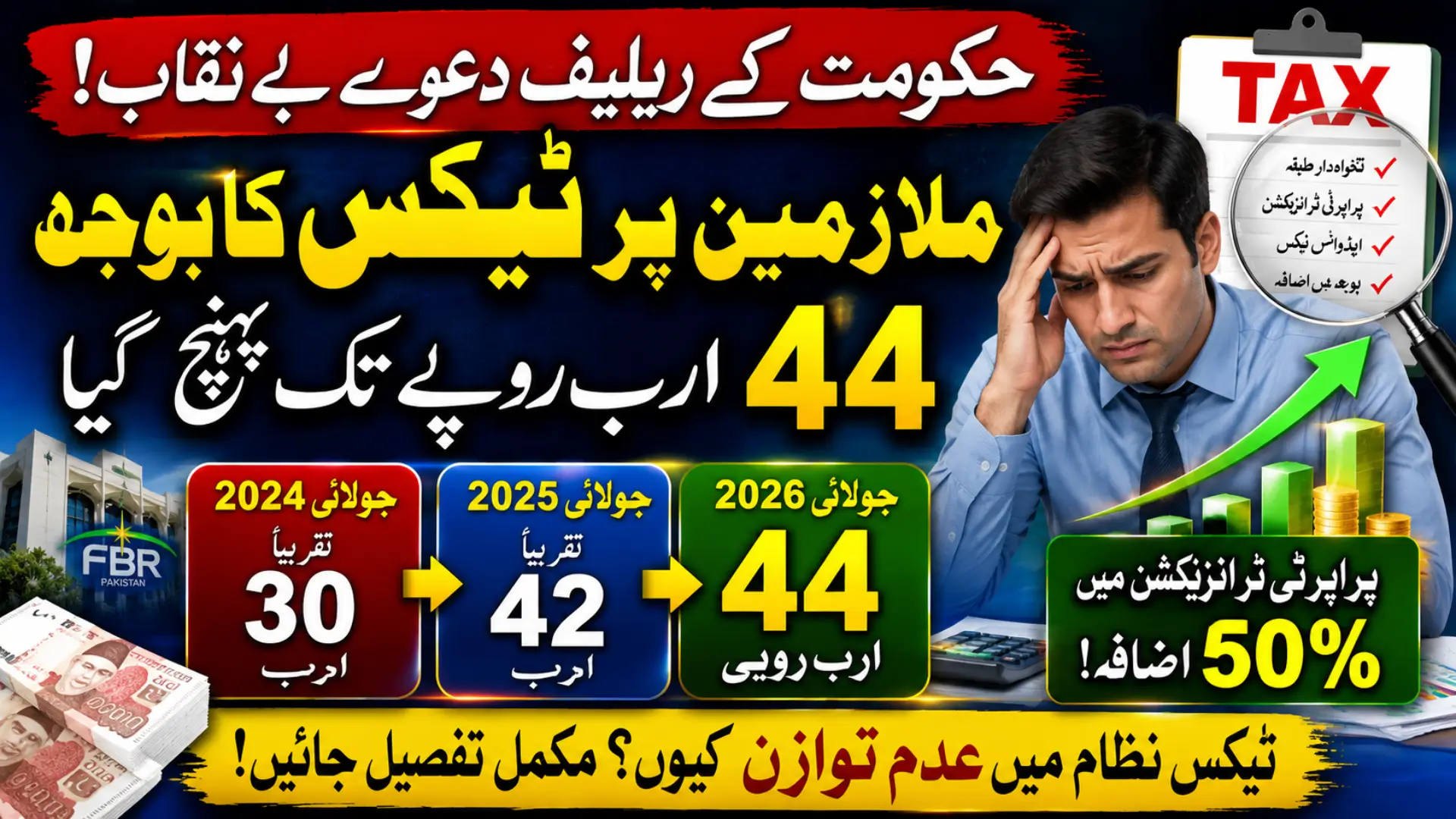
The salaried class has continued to play a major role in Pakistan’s tax collection, with income tax recovered from salaried individuals reaching Rs. 44 billion in July 2026. This was higher than the Rs. 42 billion collected in July 2025, showing that the tax contribution of employees increased by Rs. 2 billion during the first month of fiscal year 2026-27.
The rise has renewed discussion about the actual tax burden on salaried workers. While the government has repeatedly highlighted measures aimed at providing relief through changes and rationalisation of income tax rates, the latest Federal Board of Revenue (FBR) figures show that collections from salaried individuals have continued to climb.
Salaried Class Tax Collection Rises to Rs. 44 Billion
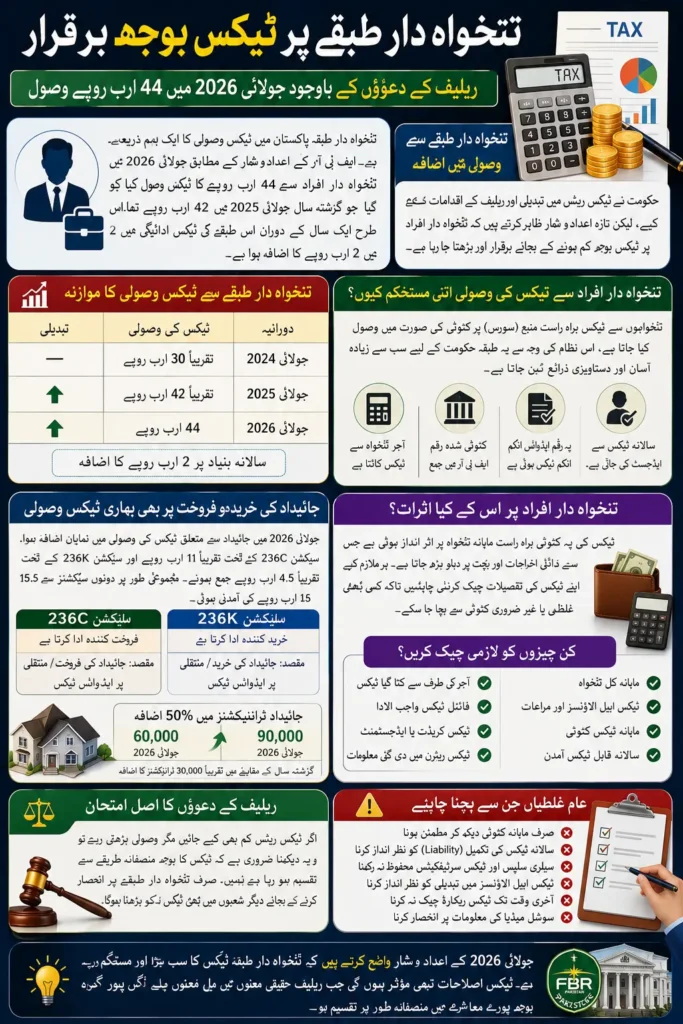
According to FBR data, tax collection from salaried individuals increased from around Rs. 42 billion in July 2025 to Rs. 44 billion in July 2026. Compared with July 2024, when collection from this segment stood at approximately Rs. 30 billion, the increase over two years is even more noticeable.
You can also read: Shahbaz Sharif 11500 Azadi Offer For
This does not necessarily mean that every salaried employee is paying a higher effective tax rate. Total collection can also be influenced by changes in salaries, employment levels, taxable income, payroll deductions and the timing of withholding. However, the figures clearly demonstrate that salaried workers remain an important and highly visible source of government revenue.
Salaried Tax Collection at a Glance
| Period | Tax Collected from Salaried Class | Change |
|---|---|---|
| July 2024 | Around Rs. 30 billion | — |
| July 2025 | Around Rs. 42 billion | Significant increase |
| July 2026 | Rs. 44 billion | Rs. 2 billion year-on-year increase |
The figures highlight a broader issue: employees working in the documented economy generally have fewer opportunities to delay or avoid tax because their employers normally deduct income tax before salaries are paid.
Why Salaried Employees Contribute So Consistently
The main reason for the strong collection from salaried individuals is the withholding tax system. Instead of asking employees to make the entire tax payment themselves at the end of the year, employers generally calculate and deduct applicable income tax from salaries and deposit it with the FBR.
This system makes salaried workers one of the easiest taxpayer groups for the government to document. Their income is linked to payroll records, employment documentation and tax filings, meaning the tax is collected regularly and directly at source.
There are several factors behind this system:
- Employers deduct applicable income tax from employees’ salaries.
- The deducted amount is deposited with the FBR.
- The deduction generally represents advance income tax.
- The amount can be adjusted against the employee’s final annual tax liability.
- Salary records make this segment relatively easy to document.
For employees, this means that tax is often paid before the money reaches their bank account. As a result, changes in taxation can have a direct effect on monthly take-home pay.
Do Higher Collections Mean Salaried Workers Are Paying More Tax?
Higher tax collection should not automatically be interpreted as proof that every salaried employee has faced a higher tax rate. Government revenue can increase because more people enter the formal workforce, salaries rise, taxable income increases or withholding calculations change.
At the same time, the continuing rise in collection provides an important measure of the financial contribution being made by documented employees. If workers receive only limited relief while their taxable income and deductions continue to increase, their overall tax outflow can still feel heavier despite changes advertised as tax relief.
Property Transactions Also Generate Significant Withholding Tax
The FBR data also showed strong withholding tax collection from real estate transactions. During July 2026, collection under Section 236C of the Income Tax Ordinance, 2001, reached around Rs. 11 billion.
Section 236C concerns advance income tax collected from the seller or transferor when immovable property is sold or transferred. Another provision, Section 236K, applies to the purchaser or transferee and generated around Rs. 4.5 billion during the same month.
Together, these two sections produced approximately Rs. 15.5 billion in July 2026.
You can also read: CM Punjab Rehmat Card 2026 Online Registration
Section 236C vs Section 236K
| Provision | Who Pays? | Purpose |
| Section 236C | Seller or transferor | Advance tax on sale or transfer of immovable property |
| Section 236K | Purchaser or transferee | Advance tax on purchase or transfer of immovable property |
These amounts are advance income tax collections linked to property transactions. The applicable rate can depend on the relevant tax regime and the taxpayer’s status.
Property Transactions Jump 50% in One Year
Another notable development was the increase in the number of property transactions. FBR data indicated that approximately 90,000 property transactions were recorded in July 2026, compared with around 60,000 transactions in July 2025.
That represents an increase of roughly 30,000 transactions, or about 50% year-on-year. The increase is significant because property transactions provide another major channel through which the government collects advance income tax.
The stronger activity may also reflect changes in the advance tax framework intended to reduce the tax burden on property transactions and encourage activity in the real estate market.
What the Numbers Mean for Salaried Workers
For salaried employees, the most important issue is not simply the headline tax collection figure. The practical question is how taxation affects monthly disposable income after salary deductions.
You can also read: Prize Bond Rs1500 Draw Scheduled for 17 August 2026
Employees should therefore examine their payslips and annual tax calculations instead of relying only on general claims about tax relief. A worker whose salary or taxable allowances have changed may experience a different tax deduction even when the applicable tax structure has also been revised.
Employees Should Check These Items
- Gross monthly salary
- Taxable allowances and benefits
- Monthly income tax deduction
- Annual taxable income
- Tax deducted by the employer
- Final annual tax liability
- Tax credit or adjustment, where applicable
- Information reported in the annual tax return
Keeping these records can help employees identify incorrect deductions and understand whether the tax deducted during the year matches their actual liability.
Government Relief Claims Face a Clearer Test
The latest collection figures have created a difficult comparison between the government’s claims of relief and the financial reality experienced by documented workers. If tax rates are reduced but total collections from salaried individuals continue to rise, the government needs to explain the reasons behind that increase clearly.
Higher revenue is not necessarily negative. Pakistan needs stronger tax collection and a broader tax base to improve public finances. The concern arises when a relatively narrow group of documented taxpayers continues to provide a large and predictable share of revenue while other segments remain less effectively documented.
A more balanced tax system would ideally increase compliance across the economy rather than placing disproportionate pressure on people whose income is already visible through formal payroll systems.
Salaried Class Remains One of the Most Documented Taxpayer Groups
The structure of salary taxation makes employees particularly important to the formal tax system. Employers generally act as withholding agents, meaning the government can collect revenue throughout the year rather than waiting for individuals to make voluntary payments.
This creates a significant compliance advantage for the government. However, it also means salaried workers have limited control over when their tax is deducted. Their monthly income is reduced at source, making taxation immediately visible in household budgets.
For policymakers, this creates a strong reason to focus on broadening the tax base. Increasing compliance among under-documented sectors could reduce the need to rely so heavily on taxpayers whose income is already captured by formal systems.
You can also read: Android 17 QPR2 Beta 3 Update With New Features
Overseas Pakistanis and Property Tax Rules
The FBR has also provided facilitation for eligible overseas Pakistanis holding a POC or NICOP who meet the prescribed non-resident conditions. Such taxpayers may be able to benefit from the applicable filer rate under the relevant property tax provisions.
Anyone involved in a property transaction should verify their taxpayer status and the applicable rules before completing the transaction. Tax treatment can vary depending on whether the individual is a resident, non-resident, filer or falls into another category under the applicable law.
Common Mistakes Salaried Employees Should Avoid
Many employees pay attention only to the amount deducted from their monthly salary and do not review their complete annual tax position. This can make it difficult to identify errors or understand whether deductions have been properly adjusted.
Some common mistakes include:
- Not checking monthly salary tax deductions.
- Assuming every deduction is the final tax liability.
- Failing to keep salary slips and tax certificates.
- Ignoring changes in taxable allowances.
- Waiting until the last moment to review tax records.
- Relying on social media claims instead of official tax information.
Employees should keep their salary records and tax documents throughout the financial year. Where the tax calculation is complicated, professional tax advice can help prevent mistakes.
What Should Happen Next?
The July 2026 figures show that Pakistan’s salaried class continues to provide a substantial and growing contribution to tax revenues. The Rs. 44 billion collection in one month, compared with around Rs. 30 billion two years earlier, makes the trend difficult to ignore.
The larger policy question is whether future tax reforms will genuinely distribute the burden more evenly. Relief for salaried workers should ultimately be judged not only by announced tax-rate changes but also by their effect on actual take-home income, disposable earnings and the overall distribution of taxation across different sectors.
Conclusion
The latest FBR figures present a mixed picture. On one side, stronger tax collection can support Pakistan’s efforts to improve revenue and reduce fiscal pressure. On the other, the continued rise in contributions from salaried individuals raises questions about how effectively the tax burden is being distributed.
With salaried tax collection reaching Rs. 44 billion in July 2026 and property-related withholding taxes adding another Rs. 15.5 billion through Sections 236C and 236K, the figures demonstrate the importance of documented taxpayers to government revenue.