
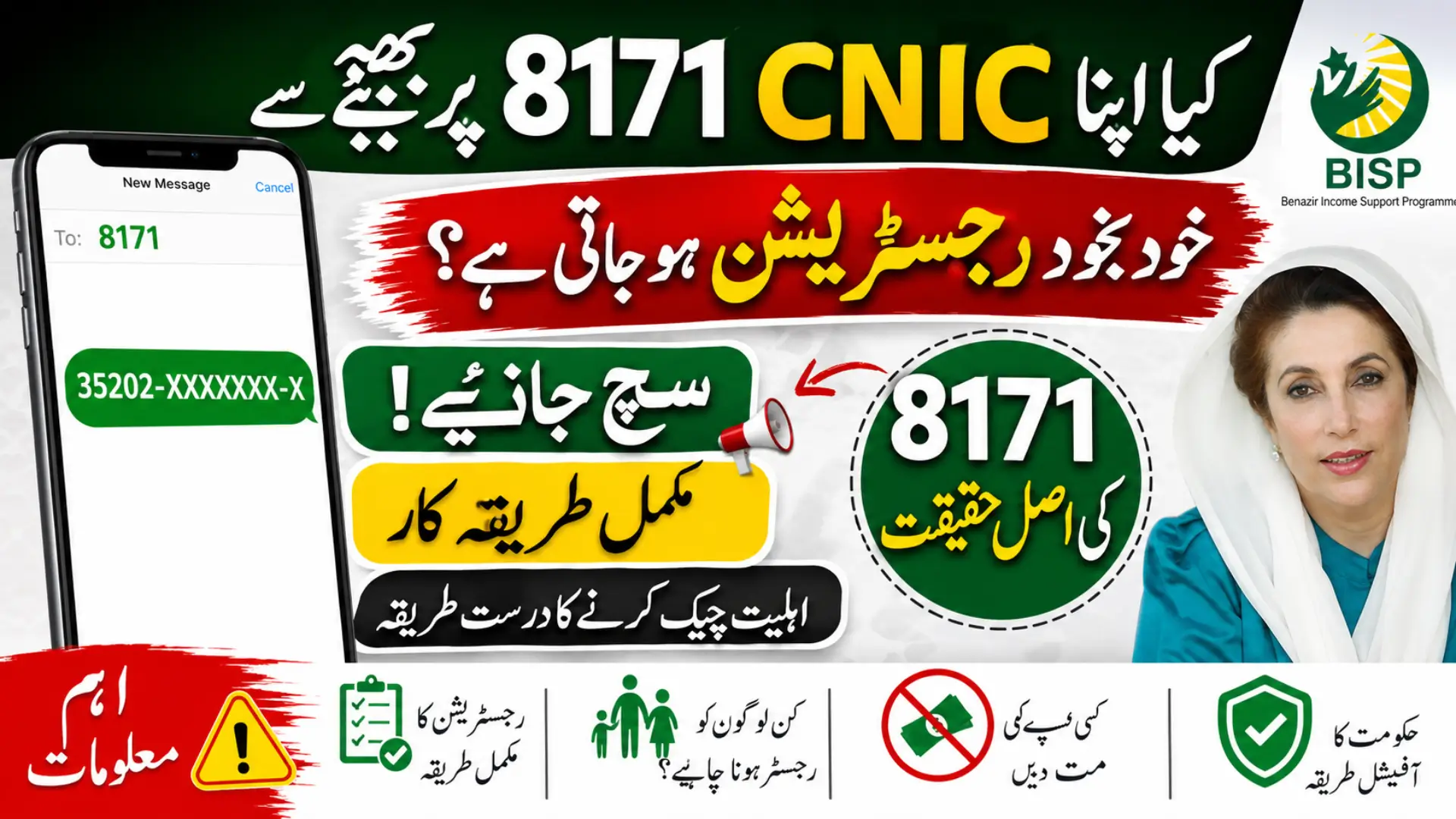
If you have heard that sending your CNIC number to 8171 automatically registers you for the Benazir Income Support Programme (BISP), it is important to understand the difference between checking your record and actually registering for the programme.
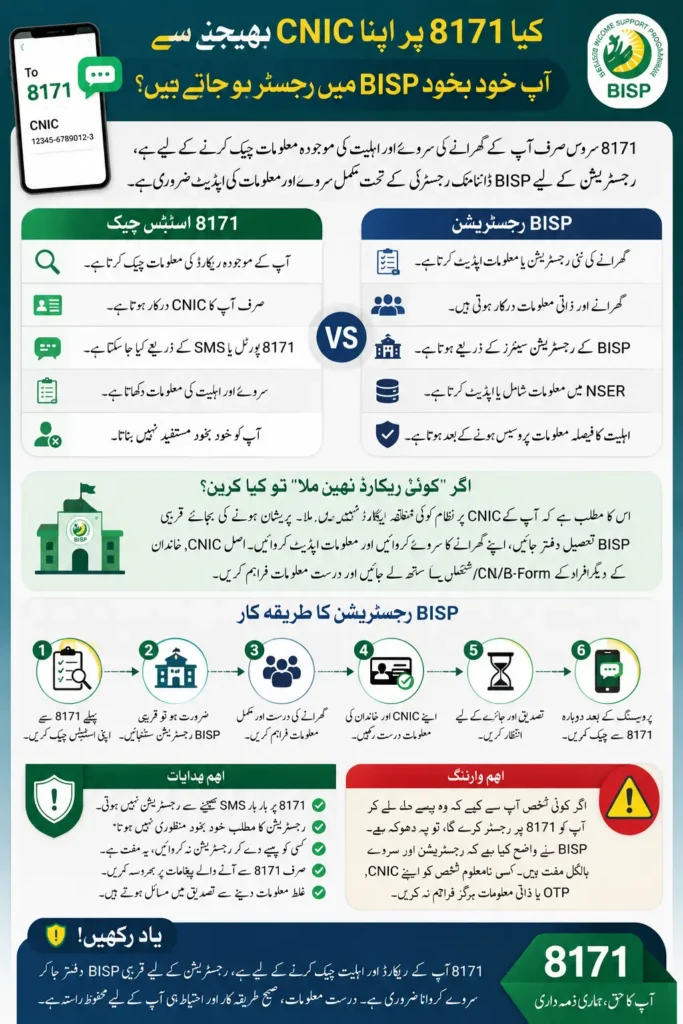
The 8171 service is primarily used to check a household’s BISP survey and eligibility status. BISP’s official information explains that citizens can check their status through the 8171 portal or by sending their CNIC number to 8171. Actual household registration and information updates are handled through the BISP Dynamic Registry process.
What Is 8171 Actually Used For?
8171 is the official BISP communication and status-checking channel. The official 8171 web portal allows users to enter their CNIC and check information about their household’s eligibility. BISP also states that 8171 is the only official number used for BISP messages, so messages claiming to represent BISP from other numbers should be treated with suspicion.
You can also read: Prize Bond Rs1500 Draw Scheduled
This means that typing or texting your CNIC does not, by itself, create a completely new BISP household record. Instead, it helps you find out what information is already available in the system and whether your household has a relevant survey or eligibility status.
8171 Check vs. BISP Registration
| 8171 Status Check | Actual BISP Registration |
|---|---|
| Checks your existing record | Creates or updates household information |
| Uses your CNIC | Requires household and personal information |
| Can be done through the 8171 portal/SMS | Normally handled through BISP’s registration infrastructure |
| Shows survey/eligibility information | Adds or updates information in the NSER |
| Does not automatically make you a beneficiary | Eligibility is assessed after the household data is processed |
The key point is simple: 8171 can tell you about your record, but an SMS should not be treated as a substitute for the household survey.
Does Sending Your CNIC to 8171 Register You?
No—not in the sense of completing the BISP household registration process. BISP documentation describes SMS to 8171 as a way to check survey and eligibility status, while registration is connected to the NSER Dynamic Registry and registration centres.
If your CNIC already has a household record, the 8171 response may tell you that information. If there is no record, repeatedly sending the same CNIC to 8171 does not replace the registration process.
What Does “No Record Found” Mean?
A “No Record Found” response generally means that the system could not find the relevant household record against the CNIC you entered. It should not be interpreted as a final statement that you can never qualify for BISP.
BISP’s own guidance says that when there is no record on the 8171 portal, an adult household member may visit the nearest Benazir registration desk at a BISP Tehsil Office for the household survey.
What You Should Do After “No Record Found”
Instead of repeatedly checking the same CNIC, take the appropriate next step:
- Visit the relevant BISP Tehsil Office/Dynamic Registry facility.
- Ask whether your household needs a new survey or an information update.
- Take your original CNIC.
- Carry relevant household members’ CNICs and children’s B-Forms where applicable.
- Provide accurate information about your household during the survey.
- Use a mobile number that you regularly access.
BISP documentation explains that registration desks are designed to deal with households that were missed from earlier surveys as well as households needing information updates.
How BISP Registration Actually Works
BISP uses the National Socio-Economic Registry (NSER) as the underlying socio-economic database for determining potential eligibility across its social protection programmes. The registry has been moving from a static system toward a Dynamic Registry, allowing household information to be added or updated through registration centres and related mechanisms.
During registration, the household’s information is collected rather than simply accepting a CNIC number. BISP’s published registration guidance includes information such as household members, education, income, assets and other socio-economic details, with CNIC information being checked against NADRA records.
You can also read: Nadra QR Code Identity Cards
Step-by-Step BISP Registration Process
1. Check your status first
Use the official 8171 portal or the 8171 SMS service to determine whether your household already has a record.
2. Visit a BISP registration facility if necessary
If your household has no record or needs an update, visit the appropriate BISP Tehsil Office/Dynamic Registry facility.
3. Provide your household information
The registration process involves questions about household members and socio-economic circumstances. Give accurate information rather than trying to provide answers that you believe will produce a particular score.
4. Make sure your identity information is accurate
CNIC and family information should be consistent with your current NADRA record. BISP’s registration material specifically highlights the importance of updated CNIC information and household documents.
5. Wait for the assessment
Registration does not mean automatic approval. Your household information must be processed and assessed according to the applicable eligibility criteria.
6. Check 8171 again
After the registration or update has been processed, you can use 8171 again to check the status of your household.
What Different 8171 Results Can Mean
The exact wording displayed can vary depending on the system and the stage of your record, so users should avoid assuming that every status means an immediate payment.
| Result | General meaning |
| Eligible | Your household has been assessed as meeting the relevant eligibility conditions for the programme |
| Not Eligible | Your household has a record but does not currently meet the applicable eligibility conditions |
| Under Process | Your survey, update, or assessment has not yet reached a final status |
| No Record Found | The system could not find the relevant record against the information checked |
An important distinction is that being registered and being eligible are not the same thing. A household can have its information recorded in the registry without qualifying for a particular BISP benefit.
Is the 8171 SMS Service Enough for Registration?
For most people asking this question, the answer is no. The SMS service is useful because it gives people a convenient way to check their existing BISP status, but it does not eliminate the need for the underlying survey or registration process where a household has not yet been recorded.
You can also read: Android 17 QPR2 Beta 3 Update
BISP’s Dynamic Registry was specifically developed to allow missed households to be registered and existing household information to be updated. Registration therefore depends on the registry process, while 8171 provides an important channel for checking status and receiving official BISP communications.
Documents and Information to Keep Ready
Before visiting a BISP registration facility, keeping your basic family information organized can make the process easier.
- Original CNIC of the relevant household member.
- CNIC information for other adult household members, where applicable.
- Children’s B-Forms where applicable.
- Correct marital and family information.
- Current household income and other relevant socio-economic information.
- A mobile number that you actively use.
BISP has also advised applicants to provide an active mobile number during the survey so that official communications can reach them.
Common Mistakes to Avoid
Many problems arise because people confuse an eligibility check with registration or rely on unofficial people claiming they can “activate” 8171.
- Sending the same CNIC repeatedly: A repeated SMS does not replace a missing survey.
- Assuming registration means approval: Being surveyed does not guarantee BISP eligibility.
- Paying someone for registration: BISP has repeatedly stated that there is no fee for its survey/registration process.
- Trusting unofficial messages: BISP says 8171 is its official number for beneficiary messages.
- Providing inaccurate family information: Incorrect information can create problems during verification.
- Ignoring outdated NADRA information: Changes in marital status, family composition or other identity information should be properly reflected where required.
Important Warning About BISP Scams
Be particularly careful if somebody tells you that you must pay money to “register your CNIC on 8171.” BISP has publicly stated that there is no fee for the survey, and it has warned beneficiaries against fraudulent messages from numbers other than 8171.
Never give your CNIC details, OTPs, PINs or payment information to an unknown person simply because they claim to be a BISP representative. If someone demands money for a BISP survey or registration, use BISP’s official complaint channels rather than paying them.
Is BISP Registration Free?
Yes. BISP has explicitly stated that there is no registration or survey fee. If someone asks for money to enter your household into the BISP system, that is not an official BISP registration charge.
This is especially important for low-income households because scammers may use the promise of faster registration, guaranteed eligibility or immediate payment to demand money.
Frequently Asked Questions
How can I register my name through 8171?
You cannot treat an 8171 SMS as a complete replacement for BISP household registration. First check your status through 8171. If your household is not recorded or needs an update, follow the BISP Dynamic Registry/registration process through the relevant BISP Tehsil Office.
Is 8171 free to use?
The official BISP 8171 service is intended for checking and communicating BISP status. If you are using SMS, your mobile operator’s normal SMS conditions may apply. BISP itself does not charge a registration or survey fee.
What does “Not Eligible” mean?
It generally means that your household has a record but does not currently meet the applicable eligibility conditions for the programme being assessed. It does not mean that sending your CNIC repeatedly will automatically change the result.
Can I register without visiting a BISP office?
The exact registration route can depend on the current Dynamic Registry arrangements and your area’s survey activity. BISP’s published material identifies Tehsil-level registration centres as a key part of the Dynamic Registry system.
What if my family information has changed?
You should use the appropriate BISP registration/update channel to report relevant changes. BISP’s Dynamic Registry is designed to support updates to household information, including roster-related changes connected with NADRA verification.
How long does registration take?
There is no reliable one-size-fits-all period for every household. Registration, verification and eligibility assessment are separate stages, so an “Under Process” result may remain until the relevant checks have been completed.
You can also read: Government Relief Claims Clash With Rising Tax Burden
The Bottom Line: Is SMS to 8171 Enough?
No. Sending your CNIC to 8171 is useful for checking your BISP record and eligibility status, but it should not be confused with completing a household registration or NSER survey.
If your record already exists, 8171 can help you understand its current status. If you receive “No Record Found,” the better approach is to follow the official BISP registration process rather than repeatedly sending the same SMS. And most importantly, never pay anyone who claims they can register you on 8171 for a fee.
Verify Before Sharing Your CNIC
For the safest check, use the official 8171 BISP portal rather than links sent through WhatsApp, Facebook or unknown SMS messages.
Visit the official BISP website
The official BISP sources confirm that 8171 is the recognized channel for BISP messages and status checking, while registration is handled through the broader Dynamic Registry process.