
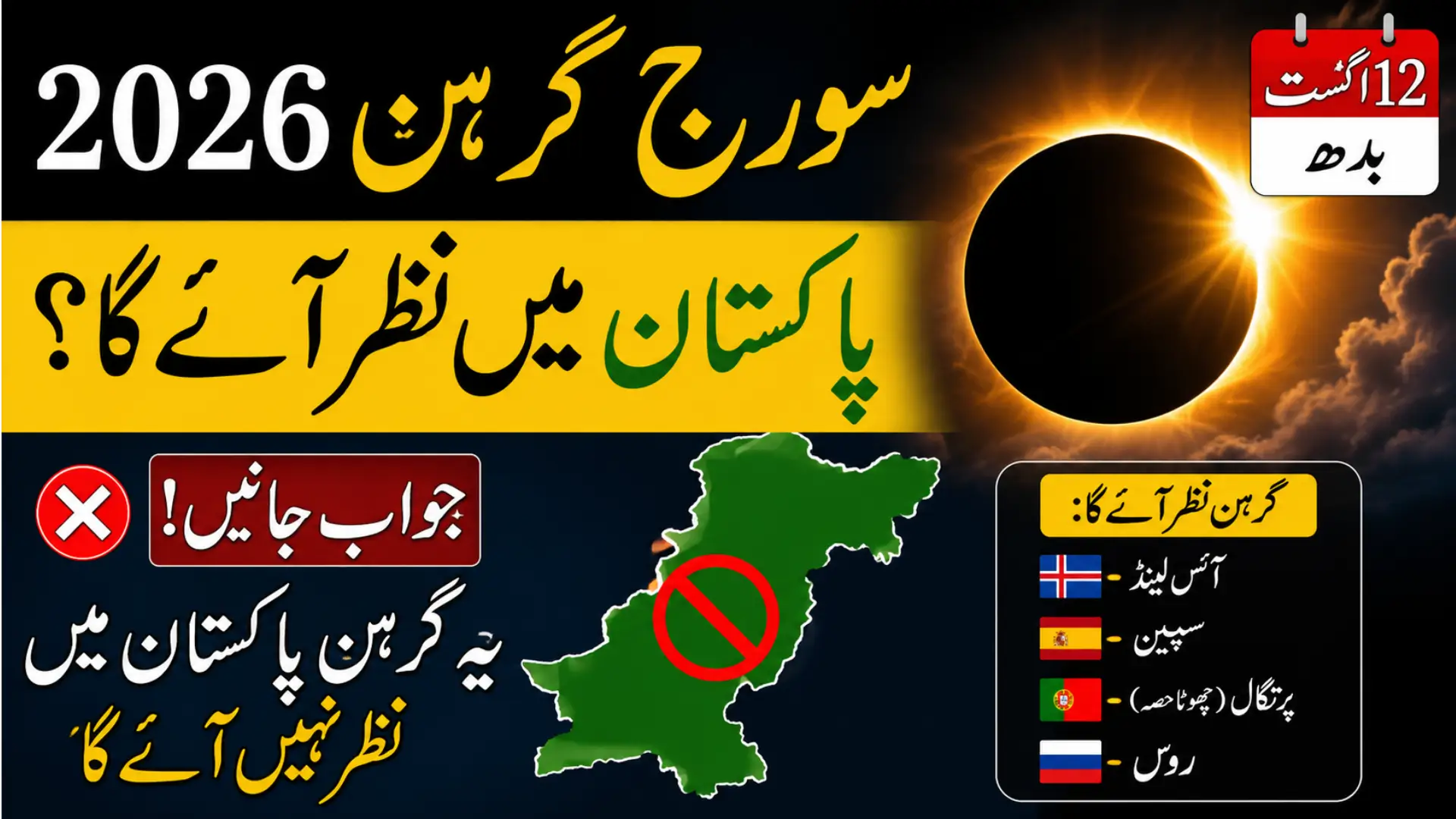
The Solar Eclipse 2026 in Pakistan is attracting attention because a total solar eclipse will occur on Wednesday, August 12, 2026. However, there is an important point for people searching for “Solar Eclipse 2026 Pakistan”: the eclipse will not be visible from Pakistan. The Pakistan Meteorological Department (PMD) confirms that the August 12 total solar eclipse will not be visible anywhere in Pakistan.
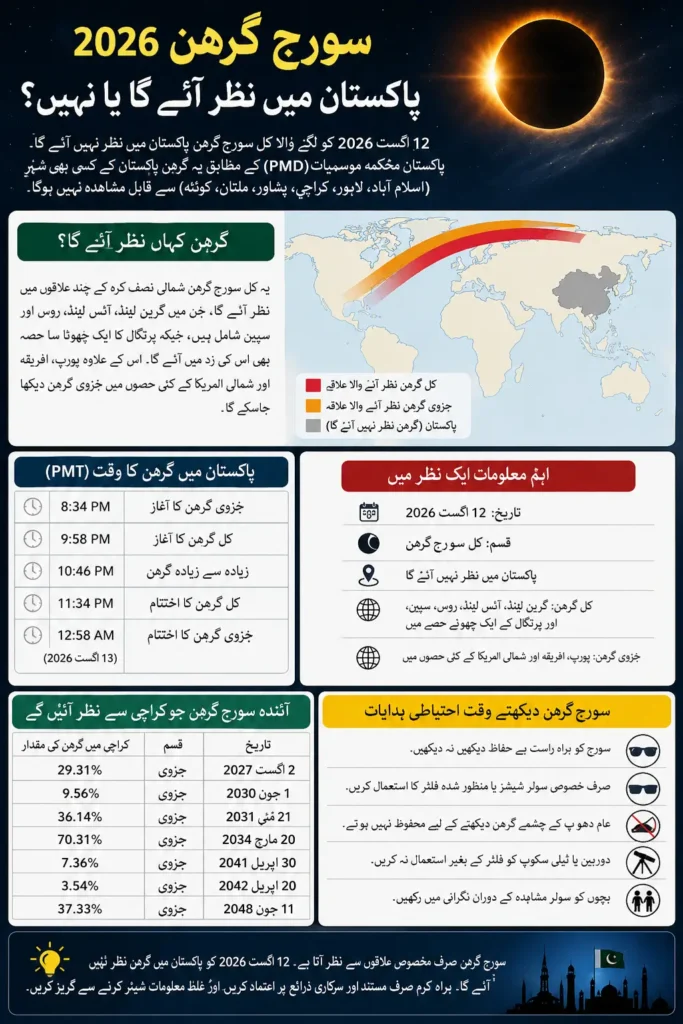
The eclipse will be visible as a total solar eclipse along a narrow path crossing parts of the Northern Hemisphere, including Greenland, Iceland, Russia and Spain, with a small area of Portugal also included. A much wider region will experience a partial eclipse.
Solar Eclipse 2026 in Pakistan: Is It Visible?
No. The August 12, 2026 solar eclipse will not be visible from Pakistan. This means people in Karachi, Lahore, Islamabad, Multan, Peshawar, Quetta and other Pakistani cities will not be able to see the Moon passing in front of the Sun from their location.
You can also read: Maryam Nawaz 2026 Azadi Package 16000
The reason is geographical. A solar eclipse can only be observed from locations that fall inside the eclipse’s visibility zone. Pakistan is outside the path of the August 2026 eclipse. For example, the detailed Karachi eclipse calculation also confirms that the event will not be visible from Karachi.
Quick Facts About the August 2026 Eclipse
| Information | Details |
|---|---|
| Date | August 12, 2026 |
| Day | Wednesday |
| Type | Total Solar Eclipse |
| Visibility in Pakistan | Not visible |
| Visibility as total | Parts of Greenland, Iceland, Russia and Spain, plus a small area of Portugal |
| Partial visibility | Parts of Europe, Africa, North America and surrounding regions |
| Karachi | Not visible |
| Lahore | Not visible |
| Islamabad | Not visible |
| Pakistan Meteorological Department | Confirms it will not be visible in Pakistan |
The total phase is restricted to a relatively narrow path. NASA’s eclipse data shows that the Moon’s umbral shadow travels across the Arctic and North Atlantic before crossing areas including Iceland and Spain.
What Time Is the Solar Eclipse 2026 in Pakistan?
People searching for the Solar Eclipse 2026 Pakistan time may find different timings online. The important distinction is between the time the eclipse is happening somewhere on Earth and whether it can actually be observed from Pakistan.
According to the Pakistan Meteorological Department’s 2026 eclipse information, the event’s calculated timings in Pakistan Standard Time are listed as beginning at 8:34 PM on August 12, with the total phase beginning at 9:58 PM, maximum eclipse at 10:46 PM, and the partial phase ending at 12:58 AM on August 13. However, these times do not mean that people in Pakistan can see the eclipse. PMD explicitly states that the eclipse will not be visible in Pakistan.
| Eclipse stage | Pakistan Standard Time |
| Partial eclipse begins | 8:34 PM, August 12 |
| Total eclipse begins | 9:58 PM |
| Maximum eclipse | 10:46 PM |
| Total eclipse ends | 11:34 PM |
| Partial eclipse ends | 12:58 AM, August 13 |
These are astronomical event timings rather than local viewing times. Since the eclipse is below the visibility conditions for Pakistan, there will be no direct solar eclipse spectacle from Pakistani cities.
Why Is the August 12 Eclipse Not Visible in Pakistan?
A solar eclipse occurs when the Moon moves between Earth and the Sun and blocks some or all of the Sun’s light for observers in certain parts of Earth. But the Moon’s shadow does not cover the entire planet. It moves across a specific geographical path.
For the August 12, 2026 eclipse, the main shadow path is concentrated much farther north and west than Pakistan. NASA’s eclipse map shows the path beginning in the far northern regions before moving through the Arctic and North Atlantic toward Iceland and Spain.
This is why an eclipse can be a major astronomical event globally while being completely invisible from another country. The same principle explains why Karachi and other Pakistani cities can have different eclipse calendars from European or North American locations.
Where Will the Solar Eclipse Be Visible?
The August 12 event is a total solar eclipse, but totality will only be visible from a narrow path. Observers inside this path can see the Moon completely cover the Sun for a short period.
NASA’s eclipse information identifies the path through the Arctic region, Iceland and Spain, while a small part of Portugal also falls within the totality path. Other areas across Europe, parts of Africa and North America can experience a partial eclipse.
Some important viewing regions include:
- Greenland
- Iceland
- Northern Russia
- Spain
- A small part of Portugal
- Parts of Europe for a partial eclipse
- Parts of North America for a partial eclipse
- Parts of northern Africa for a partial eclipse
The exact percentage of the Sun covered depends on the observer’s location. Being outside the totality path does not necessarily mean an eclipse cannot be seen; it may simply appear as a partial eclipse if the location lies within the wider penumbral region.
You can also read: Maryam Nawaz 16000 Azadi Scheme
Solar Eclipse 2026 in Karachi
For Karachi residents, the answer is straightforward: the August 12, 2026 solar eclipse will not be visible. The detailed location-specific eclipse calculation for Karachi lists the event as not visible from the city.
Therefore, there is no special viewing time, maximum eclipse time or safe outdoor observation period to plan for Karachi. Online posts claiming that residents of Karachi will see the Sun become partially or completely covered on August 12 should be checked carefully against reliable astronomical data.
Solar Eclipse 2026 in Lahore, Islamabad and Other Cities
The same conclusion applies across Pakistan. The eclipse path does not reach the country, so moving from Karachi to Lahore or Islamabad will not make the August 12 eclipse visible.
People should also avoid confusing Pakistan Standard Time timings with visibility. An astronomical event can have a calculated time relative to Pakistan even when the Sun is not positioned for observers in that country to see the event.
Is It Safe to Look at a Solar Eclipse?
Solar eclipses require proper eye protection whenever the Sun is being viewed directly. Looking at the Sun without appropriate solar viewing equipment can cause serious and permanent eye damage.
If you travel to a location where the eclipse is visible, use certified solar-viewing equipment designed specifically for direct solar observation. Ordinary sunglasses, camera filters, homemade dark glass and similar substitutes should not be treated as safe solar filters.
Important Solar Viewing Safety Tips
- Never stare directly at the Sun without proper solar protection.
- Use eclipse glasses or solar viewers that meet the appropriate safety standard.
- Do not use ordinary sunglasses as eclipse protection.
- Do not look through binoculars or a telescope at the Sun without a proper solar filter fitted correctly.
- Children should be supervised during solar observations.
- Follow instructions from reputable astronomical organizations and eclipse experts.
The safety issue remains important even during a partial eclipse because a visible portion of the Sun can still be extremely bright.
Solar Eclipse vs Lunar Eclipse: Why Visibility Is Different
A solar eclipse and a lunar eclipse do not have the same visibility pattern. A solar eclipse is visible only from a relatively limited region of Earth because the Moon’s shadow falls across a narrow part of the planet.
A lunar eclipse can generally be seen from a much larger part of the nighttime side of Earth because observers are watching Earth’s shadow move across the Moon. This difference is one reason why a solar eclipse may be visible in Europe but completely absent from Pakistan on the same date.
What Is the Next Solar Eclipse Visible From Karachi?
Although the August 12, 2026 eclipse will not be visible in Karachi, future solar eclipses will be observable from the city. The next listed solar eclipse visible from Karachi is a partial solar eclipse on August 2, 2027, with a magnitude of about 0.4026 and approximately 29.31% obscuration.
Other future partial eclipses listed for Karachi include events in 2030, 2031 and 2034. The 2034 eclipse is particularly notable in the listed data, with about 70.31% obscuration from Karachi.
| Date | Visibility from Karachi | Approx. obscuration |
| August 2, 2027 | Partial | 29.31% |
| June 1, 2030 | Partial | 9.56% |
| May 21, 2031 | Partial | 36.14% |
| March 20, 2034 | Partial | 70.31% |
| April 30, 2041 | Partial | 7.36% |
| April 20, 2042 | Partial | 3.54% |
| June 11, 2048 | Partial | 37.33% |
These percentages describe the amount of the Sun’s apparent diameter/area covered according to the eclipse calculation system being used, so they should not automatically be interpreted as the percentage of daylight that disappears.
Common Mistakes About Solar Eclipse 2026 in Pakistan
One common mistake is assuming that because an eclipse is happening on August 12, everyone can watch it. Solar eclipses are highly location-dependent, and Pakistan falls outside the visibility area for this particular event.
You can also read: Punjab All Educational Boards Result Schedule 2026
Another mistake is sharing a time without checking the location. Search results may show eclipse times in UTC, Pakistan Standard Time or the local time of a country inside the eclipse path. Always verify whether the eclipse is actually visible from your city before planning an observation.
Things to Check Before Sharing Eclipse Information
- Confirm the exact date and eclipse type.
- Check whether Pakistan is inside the visibility region.
- Verify city-specific visibility instead of relying only on national information.
- Distinguish between total and partial eclipse visibility.
- Check the source of any claimed viewing time.
- Never share unsafe advice about looking directly at the Sun.
Latest Update on Solar Eclipse 2026 in Pakistan
As of August 12, 2026, the most important update for Pakistani viewers remains unchanged: the August 12 total solar eclipse will not be visible from Pakistan. This is supported by the Pakistan Meteorological Department and location-specific astronomical calculations for Karachi.
For people interested in seeing the eclipse itself, the best option is to follow a reliable live broadcast or travel to an appropriate location within the eclipse’s visibility region. NASA has also published maps and visualizations showing the eclipse’s shadow path and the areas affected by total and partial phases.
Frequently Asked Questions
Will the Solar Eclipse be visible in Pakistan on August 12, 2026?
No. The August 12, 2026 total solar eclipse will not be visible from Pakistan, according to the Pakistan Meteorological Department.
Can I see the August 2026 eclipse from Karachi?
No. The eclipse is specifically listed as not visible from Karachi.
What time is the Solar Eclipse 2026 in Pakistan?
PMD lists the calculated event beginning at 8:34 PM Pakistan Standard Time on August 12, but it will not be observable from Pakistan.
Where can the 2026 total solar eclipse be seen?
Totality will be visible along a narrow path covering parts of Greenland, Iceland, Russia, Spain and a small area of Portugal.
What is the next solar eclipse visible from Karachi?
The next listed solar eclipse visible from Karachi is a partial eclipse on August 2, 2027.
Is it safe to watch a solar eclipse with normal sunglasses?
No. Ordinary sunglasses are not designed for direct solar viewing. Proper solar viewing equipment should be used when observing a solar eclipse.
Conclusion
The Solar Eclipse 2026 in Pakistan is a significant astronomical event, but Pakistani viewers will not be able to see it directly. The total solar eclipse occurs on August 12, 2026, with its totality path passing through parts of the far Northern Hemisphere and areas including Iceland and Spain.
You can also read: Bacchon Ka Vajifa Check Karne ka Tarika
For Pakistan, the key point is simple: there will be no visible solar eclipse on August 12, 2026. Anyone looking for an eclipse that can actually be observed from Pakistan should instead check the upcoming August 2, 2027 partial solar eclipse, which is listed as visible from Karachi.