
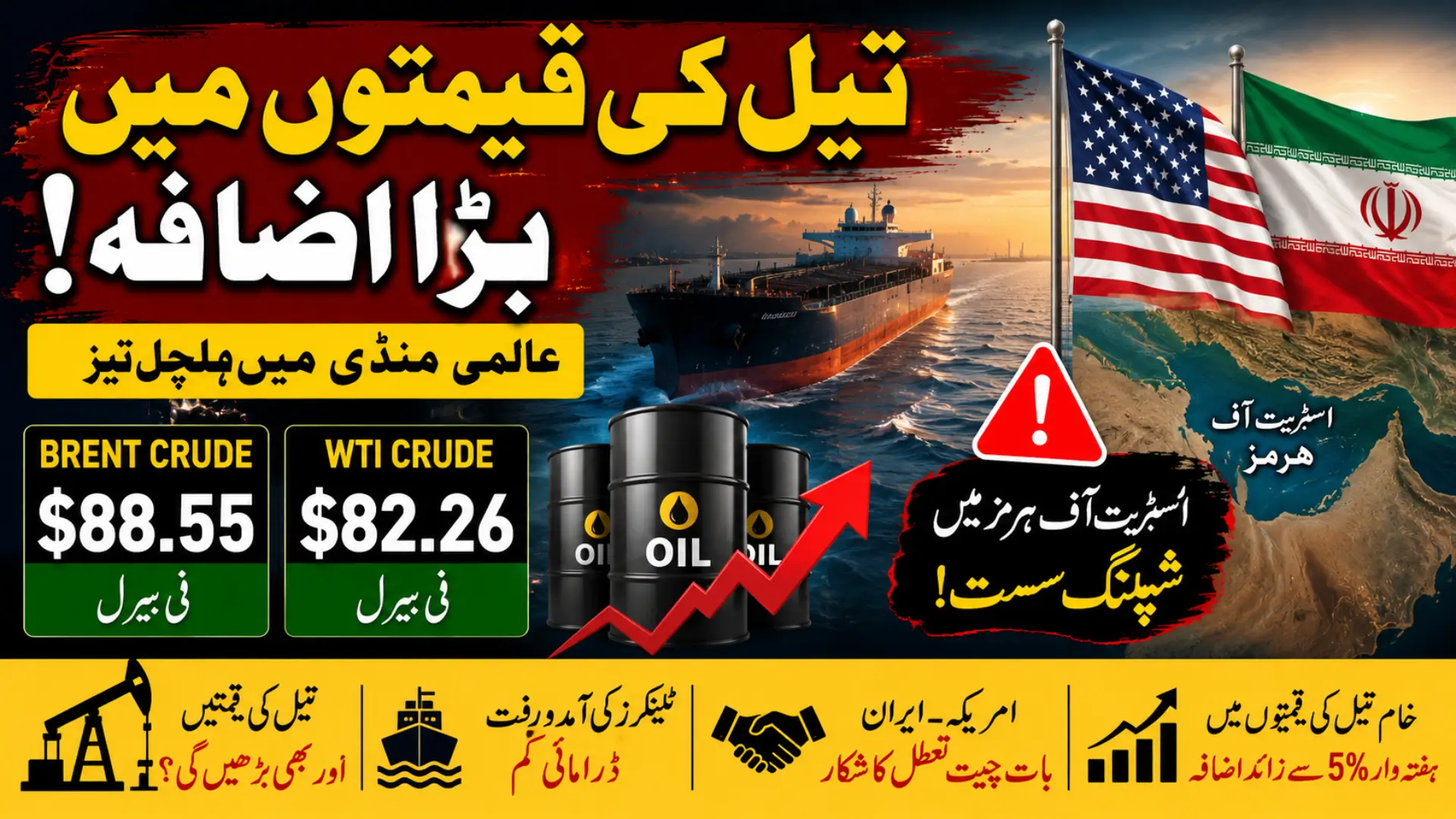
Global oil prices remained elevated on Monday as markets reacted to weakening prospects for progress in U.S.-Iran peace talks and a sharp slowdown in shipping through the Strait of Hormuz. Brent crude was trading around $88.55 per barrel, while U.S. West Texas Intermediate (WTI) stood near $82.26 per barrel in early trading. Reuters reported that both benchmarks had gained more than 5% during the previous week.
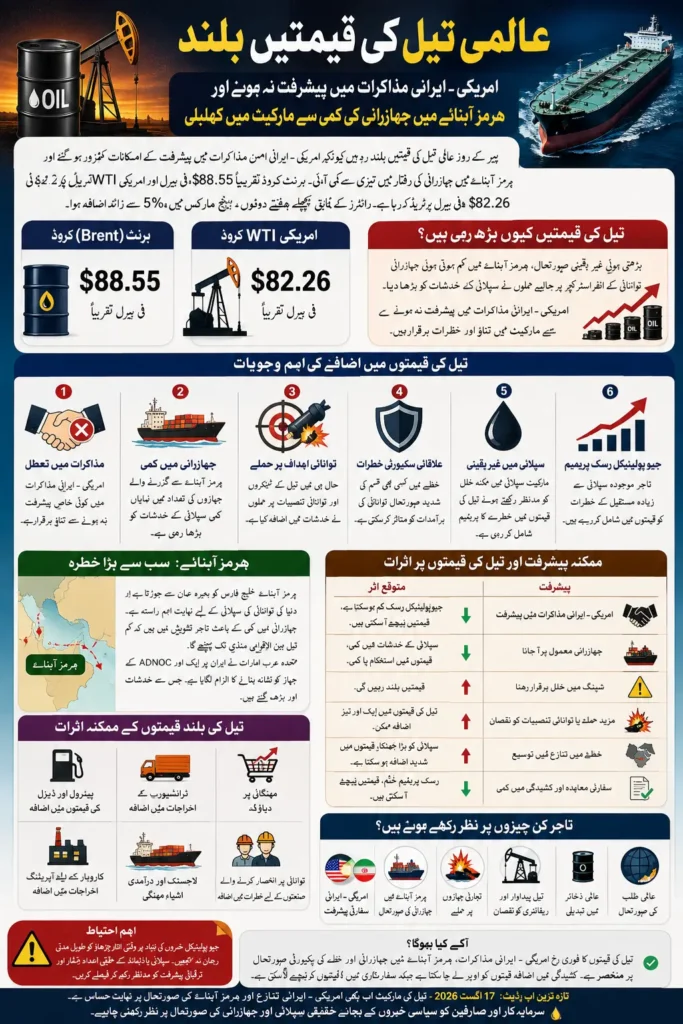
The latest movement shows how strongly geopolitical developments are influencing the oil market. Traders are not only watching actual disruptions to crude supplies but are also pricing in the possibility that tensions could worsen. Any further reduction in tanker traffic through the Strait of Hormuz could increase concerns about global energy supplies and keep crude prices under upward pressure.
Why Are Oil Prices Rising?
The main reason behind the recent strength in crude prices is the growing uncertainty surrounding oil supplies from the Middle East. The Strait of Hormuz is one of the world’s most important energy shipping routes, so any prolonged disruption can quickly change expectations in global oil markets.
You can also read: Google Pixel 11 Pro Price in Pakistan 2026
Recent attacks involving vessels and energy infrastructure have added to those concerns. At the same time, diplomatic efforts between Washington and Tehran have failed to provide the market with a clear path toward de-escalation. Reuters reported that tanker traffic through the strait had fallen dramatically, with only five commodity vessels crossing on Saturday and none on Sunday, compared with 31 vessels during the previous weekend.
Key Factors Supporting Higher Oil Prices
Several developments are currently being monitored by traders:
- Stalled U.S.-Iran negotiations: The lack of progress has reduced hopes for a quick reduction in tensions.
- Slower tanker traffic: Fewer vessels moving through the Strait of Hormuz have increased supply concerns.
- Attacks on energy-related targets: Recent incidents have raised fears of further damage to oil infrastructure.
- Regional security risks: Any escalation could create additional pressure on Middle Eastern energy exports.
- Supply uncertainty: Traders are adding a geopolitical risk premium to crude prices.
The combination of these factors has kept oil prices well above their recent lows.
Strait of Hormuz Remains the Biggest Market Risk
The Strait of Hormuz is strategically important because it connects the Persian Gulf with the Arabian Sea and provides a major route for energy shipments. When shipping activity through the waterway slows, traders immediately consider whether fewer barrels will reach international markets.
The current situation is particularly sensitive because the reduction in vessel movements is happening alongside continued political and military tensions. Reuters reported that the United Arab Emirates has also accused Iran of targeting another ADNOC-operated vessel, adding to concerns about the safety of commercial shipping.
What Could Happen if Disruptions Continue?
The effect on oil prices would depend on the scale and duration of the disruption. A temporary slowdown may create volatility, while a prolonged interruption could produce much stronger supply concerns.
| Market Development | Likely Impact on Oil |
|---|---|
| U.S.-Iran talks make progress | Could reduce geopolitical risk and push prices lower |
| Tanker traffic resumes normally | Could ease supply concerns |
| Shipping disruption continues | Could keep prices elevated |
| More vessels are attacked | Could trigger another sharp price increase |
| Conflict expands across the region | Could create a much larger supply shock |
| Diplomatic agreement breaks tensions | Could remove part of the risk premium |
The key point is that oil prices are reacting not only to current supply levels but also to what traders believe could happen next.
What Happened to Brent and WTI?
Brent crude and WTI both recorded strong gains during the previous week. Reuters reported that the two benchmarks rose by more than 5%, reflecting renewed concerns over Middle Eastern supply disruptions.
Early Monday trading showed some stabilization rather than another dramatic surge. Brent was around $88.55 and WTI around $82.26 in the figures cited in the initial market report. Reuters later reported that Brent had briefly climbed as high as $89.40 and WTI reached $82.83 during the session, highlighting the volatility surrounding the market.
You can also read: Android 17 QPR2 Beta 3 Update
Will Oil Prices Go Even Higher?
A further rise is possible if tensions between the United States and Iran intensify or shipping through the Strait of Hormuz falls even further. However, higher prices are not guaranteed because oil markets also respond to demand, inventories, production and economic growth.
This is important for readers following crude oil prices because geopolitical headlines can cause sharp short-term moves, but longer-term prices depend on whether an actual and sustained supply shortage develops. Current market commentary also points to weaker demand as a factor that could limit how far prices rise.
Three Developments Traders Are Watching
The next major oil-price moves are likely to depend on:
- U.S.-Iran diplomacy — Any meaningful progress could reduce the geopolitical premium in crude.
- Hormuz shipping activity — A return of normal tanker traffic could ease supply fears.
- Regional escalation — New attacks or damage to energy infrastructure could push prices higher.
For consumers, businesses and investors, these developments are more important than focusing on a single day’s crude price.
How Higher Oil Prices Could Affect Consumers
When international crude prices remain high, the effects can eventually spread beyond the oil market. Refiners, transportation companies and other energy-intensive businesses may face higher costs, which can influence fuel prices and the prices of goods transported by road, sea or air.
The impact on individual consumers varies by country because local fuel prices also depend on taxes, exchange rates, refining costs and government pricing policies. Therefore, a rise in Brent crude does not automatically translate into the same percentage increase at petrol stations.
Possible Effects of Prolonged High Oil Prices
- Higher petrol and diesel costs
- Increased transportation expenses
- Greater pressure on inflation
- Higher operating costs for businesses
- More expensive logistics and imported goods
- Increased uncertainty for energy-dependent industries
These effects become more significant if elevated crude prices continue for an extended period rather than lasting only a few trading sessions.
What Should Readers Watch in the Coming Days?
The oil market is currently highly sensitive to geopolitical headlines. A single announcement regarding negotiations, shipping restrictions or regional security could quickly change market expectations.
For that reason, readers should avoid treating every intraday oil-price movement as a confirmed long-term trend. The more useful approach is to monitor several indicators together and look for evidence of a sustained change in physical oil supply.
Practical Indicators to Follow
- Brent and WTI price movements
- Tanker traffic through the Strait of Hormuz
- U.S.-Iran diplomatic developments
- Attacks involving commercial vessels
- Damage to oil production or refining facilities
- Global crude inventories
- OPEC and major producers’ output
- Signs of weakening or strengthening global demand
Watching these factors together provides a clearer picture than following political headlines alone.
You can also read: Relief Claims Clash With Rising Tax Burden
Common Mistakes When Reading Oil Price News
One common mistake is assuming that every geopolitical threat will automatically send oil prices sharply higher. Markets usually react to the expected effect on actual supply, not simply to the existence of political tension.
Another mistake is confusing a temporary price spike with a lasting supply crisis. If shipping resumes and diplomatic tensions ease, some of the geopolitical premium can disappear quickly. Conversely, if disruptions become widespread and persistent, the market reaction could be much stronger.
What Happens Next?
The immediate direction of oil prices will largely depend on developments between the United States and Iran and the level of shipping activity through the Strait of Hormuz. With negotiations showing limited progress and vessel traffic slowing sharply, traders remain cautious about the possibility of further supply disruptions.
At the same time, oil prices face competing forces. Geopolitical risks are supporting crude, while weaker demand and other market fundamentals can limit gains. This means volatility is likely to remain high until there is clearer evidence that the regional supply risk is either increasing or fading.
Conclusion
The latest oil-market rally is primarily a story of geopolitical risk and supply uncertainty. Brent crude remains close to $90 per barrel, while WTI is above $82, after both benchmarks posted gains of more than 5% in the previous week.
You can also read: BISP Registration Through 8171: Is the SMS Method
For now, the most important factors are the stalled U.S.-Iran talks, the reduced flow of vessels through the Strait of Hormuz and the possibility of further attacks or disruptions. If diplomacy improves and shipping normalizes, oil prices could lose some of their recent gains. But if tensions escalate and energy shipments remain restricted, crude prices could face renewed upward pressure.